I took the wrong bus leaving my workshop with Colegio Maria Cano in Granizal today, and ended up on a street corner loaded with prostitutes, midday. Luckily my sense of direction guided me back to the more familiar area, which was surprisingly not very far.
There are a lot of homeless people in New York, but there are a real lot here. One man was seated right in the middle of the sidewalk filling up his crack pipe with powder that looked almost silvery. Any time of day, all over the place, there are people sleeping in front of closed shops. Little kids will walk up to me in the middle of the night begging.
Yesterday, a nice guy selling candies on the bus without any front teeth identified my appearance as distinct and wanted to have a quick English class. He said he applied to work for some center where English was a requirement, but they said he couldn't speak clearly enough, so he can't find work other than hopping onto buses and selling candies. This is as common here as musicians in the New York subway, if not more so. Occasionally there are kids selling candy "for the basketball team" in NYC. But interestingly, here the vendors throw the product into your lap, or put it directly in your hands, through the whole bus, give their speech about how delicious the candy is, then walk back through the bus for people to either return the candy or pay for it. The same thing happens in cabs: at stop lights people toss bags of chips into the cab onto your lap, then come back around to retrieve it.
The streets are loaded with pirated DVDs and pornos. The most interesting to me, is there are tons of people walking around with briefcases around their necks full of gum, candies, and cigarettes. The gum costs the equivalent of 5 cents. Not to mention all the people selling cell phone minutes of the street. Or the guys walking around with carts loaded with aguacates (somehow always 'los mejores aguagates'), or guayabana, or other fruits, and a megaphone repeating their product and price. Certainly in Times Square there are the African men selling brand imitation purses that they wrap up in a sheet and throw over their shoulder when police walk by, and the old women who wandered my street in Long Island City collecting bottles and cans to recycle, but the masses of people here selling something or living in the street (not to equate the two) is daunting.
Not that I haven't thought about it thoroughly before, but I thought about it today and it was almost as though all my philosophy fell away. What do I know of these lives of the street? Little. I was handing out fliers in Times Square for a little bit, repeating myself all day, to support myself when I started living in New York. And I've listened to stories of being on the street from people here and in NYC in my work. But I've never touched that particular monotony, chaos, insecurity. Pity can be inherently demeaning, so I want to avoid 'feeling sorry' for other people and somehow making myself the 'not pitiful.' What's the positive? A different sort of freedom? If I take Zen seriously than the repetition of a street vendor should be a delightful way to touch the infinite, should it be treated as such. And haven't the great mystics been wanderers?
The fact that I really go back and forth with my feelings on this I find interesting. Sometimes I'll have no problem with the experience of a street person being as justifiable a way of living as anything else. Maybe someone wanders in a field of bliss as he searches through trash cans. How am I to know? Then there are days like today when I start feeling sorry for people. If I'm going to say 'yes' to life, don't I have to say 'yes' to poverty and suffering as part of life? I think when I see poverty of such a massive scale it feels more systemic. Or rather, it seems even more inescapable.
Part of this reaction emerges after seeing 'La Sociedad del Semaforo' which translates to 'The Society of the Traffic Light.' It's a movie about street performers and vagrants at a particular intersection in Bogota. It used non-actors for a naturalistic acting style amidst an often dream-like disjointed directional style. The film opens with an entire highway full of ambulances blasting their sirens and honking, unable to move forward. The principal character vacillates between intelligent and sensitive in moments, turning traffic noise into jazz, to drug driven madness, stabbing a security guard to steal a pair of baby shoes that he later puts onto a dog. At the conclusion of the film, the intersection explodes in anarchy from the 'paisos' after one of them dies in jail.
And where am I in this? Watching a movie about it. Writing about it on the internet. Passing through the street to my little house where breakfast is prepared for me every morning. Taking cabs often. Not flinching to treat friends to coffee or dinner because everything is so comparatively cheap. Going into schools and groups affected by poverty and violence, giving a different sort of relational experience and a different type of opportunity for personal expression.
I wonder, if someone here had to choose between an opportunity to really express themselves, and to be heard, or $50, what they would choose? It depends on the person and the level of poverty, but I'm leaning towards $50. That's 100,000 pesos. Resource based development is certainly different than offering 'cultural' programs. Of course I believe both are necessary. With poverty of this scale, I better be damn sure theatre is necessary. Although life isn't about eating, people must eat. A fasting monk chooses his hunger, and then can have a powerful experience. Let’s not get into the hierarchy of needs...
Am I looking for my own affirmation in this blog entry, feeling odd playing theatre games in the third world? I get affirmation of the experience I offer every class I teach. For example, the class at the University of Antioquia went excellent today. We met at MAM (Museo de Arte Moderno) in a studio space because the University remains closed. The students were excited just to have the opportunity to be in class. A group hug, an applause at the end of class, beaming smiles. I need to stay with this joy and connection instead of worrying about the man smoking crack in the middle of the street.
There's a cat that meows outside my window every night. I can assume it meows because it’s hungry and is asking me for food, or I can assume it meows at its pleasure, singing to the stars and the streetlight sparkling mountainside.
Thursday, September 30, 2010
El Semaforo es Rojo, Para Otros

Tuesday, September 28, 2010
El Semaforo es Verde
-I rode on the back of a motorcycle for the second time today
-Saw a performance at Nuestra Gente, 'Te Toca?' which I saw part of and commented on during the rehearsal process, so it was very cool to see the final product, with things I suggested changed, new scenes, and I was also touched when they used one of the exercises I did with them as a part of one of their scenes. One new scene in particular with people stranded on a desert island I found especially intelligent.
-I started working with a theatre group in barrio Popular, APICP, for the Imagineros organization. A small group who wants to focus on 'Theatre of the Oppressed' proper. It looks like I may be able to have my cake and eat it in regards to other traveling, if everything works out.
-I went to a concert of 'La Prohibida' of Spain in El Poblado.
-Visited an organization in Floresta for the mentally handicapped where Danny works and watched part of his 'bodily expression' class. One boy who lived in the US for a while had a 'Best Buddies' shirt on.
-Played billiards. I am terrible at billiards.
-Saw the film 'La Sociedad del Semaforo' from Colombian director Ruben Mendoza, filmed in Bogota. Upsetting but good.
-Had hot chocolate and cheese buns with the Circo Momo teachers.
Ja. Mucho trabajo. Pero mucho divertido tambien.
-Saw a performance at Nuestra Gente, 'Te Toca?' which I saw part of and commented on during the rehearsal process, so it was very cool to see the final product, with things I suggested changed, new scenes, and I was also touched when they used one of the exercises I did with them as a part of one of their scenes. One new scene in particular with people stranded on a desert island I found especially intelligent.
-I started working with a theatre group in barrio Popular, APICP, for the Imagineros organization. A small group who wants to focus on 'Theatre of the Oppressed' proper. It looks like I may be able to have my cake and eat it in regards to other traveling, if everything works out.
-I went to a concert of 'La Prohibida' of Spain in El Poblado.
-Visited an organization in Floresta for the mentally handicapped where Danny works and watched part of his 'bodily expression' class. One boy who lived in the US for a while had a 'Best Buddies' shirt on.
-Played billiards. I am terrible at billiards.
-Saw the film 'La Sociedad del Semaforo' from Colombian director Ruben Mendoza, filmed in Bogota. Upsetting but good.
-Had hot chocolate and cheese buns with the Circo Momo teachers.
Ja. Mucho trabajo. Pero mucho divertido tambien.
Wednesday, September 22, 2010
Hippopotamus: Enemy of the State

I began last night at a talk with Antonio Caro, the man who created this image, probably Colombia's most famous living artist, at the Museo de Arte Moderno. He is just the type of absurd intelligent fellow I like to listen to.
After some wine and an interesting Q & A, Caro gave out copies of his new art piece. Then I left with Juan to stop by 'La Oficina.' On the drive we went by 'Dallas' (a name coming from the American TV show) and 'OVNI' (which stands for 'Objeto volante no identificado,' UFO in English), two buildings that used to be owned by Pablo Escobar. Dallas has been bombed out and abandoned, and many believe it should remain that way, as a monument to that part of Colombia's history.

At La Oficina in El Poblado, Alberto Sierra, the curator, Roberto Luis Jaramillo, the historian who I was glad to have the opportunity to thank in person for connecting me with his friend Christian in Manizales, which gave me the chance to go horseback riding on the mountainside, Roderigo Callejas Vieira, a Colombian-Willie-Nelson-type painter, sculptor, retired professor from the Universidad Nacional, and two other men who left before I could talk more to them, were seated around a kitchen table, looking carefully through old photographs from the 30's and 40's from Medellin, and Roberto Luis, the man/encyclopedia, was explaining who everyone was in the photographs, and where they were, just by looking at them for the first time. They were preparing for the next exhibition at the gallery where these photographs are to be expanded and presented. I sat around drinking whiskey with this group of old men, eating almonds and figs, listening to stories from Colombia's history, accompanied by a plethora of dirty jokes. Looking at the faces of powerful men in an era referred to here as 'La Violencia' beginning in the late forties, I felt chills. There are also some very cool photographs taken using a rotating camera that present an entire panorama.
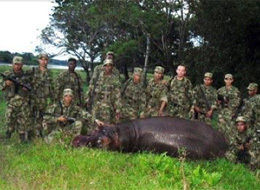
Then we walked around the excellent new gallery exhibition. A piece with 7000 toy soldiers lined up against a single toy hippopotamus, refers to an absurd incident when after Pablo Escobar was killed, his personal zoo was abandoned, and nobody wanted to enter his land. One hippo escaped in the search for food. This hippo, since it belonged to Pablo Escobar, was tracked down by the army and killed. Here is a picture of the group of soldiers celebrating their victory:
 Another piece, has a wall covered in framed little plastic bags, and next to it, a device with a motor and a fan, and a plastic bag attached to it, replicating the action of huffing glue from these little plastic bags that is common among some poor children here. I found this piece very upsetting. The rhythm of the fan increasing and decreasing meshed with the repeated image of the bag was haunting, suffocating.
Monday morning I spent a couple hours in a meeting of thirty women at 'Mujeres Que Creen' to discuss properties of plants and the concept of 'Ecofeminism.' Me and Juan were the only males in the room. I sat next to Olga Patinio, an expert on plants who spent many years in the jungle in an apprenticeship with a native Shaman to learn what she knows. And it is clear in her delightful demeanor. She got up to speak; and she can control a room in an instant, turning from utterly entertaining to sincere and meditative on a dime. They've invited me to return as these talks continue, so I'm going to try to be there when my schedule abides.
I've been offered another job during my remaining time here, working for a group called 'Imagineros.' It would mean a substantial time commitment on a very specific schedule, such that I probably wouldn't be able to do some traveling I was thinking about doing. The project is funded by the Alcaldia, the city government, so it might be a really great opportunity. Just yesterday afternoon I was getting details on the six day jungle trek I can take, and I really would love to attend the International Theatre Festival in Manizales at the end of October. But it looks like if I take this job, I wouldn't be able to do either. Colombia, you tease!
Sunday, September 19, 2010
Papas Fritas
The University of Antioquia is closed down, at least until Monday, but possibly for longer, in order to 'restore security.' The 'Assemblies,' the student organizations which present political opposition, have been quite active in the past week. For students, the sound of 'papas,' little bombs going off, and people in masks running around, are not exactly uncommon. Although most Universities are five years long here, it is rare for students to leave the University of Antioquia in five years, because it is often organized within certain majors for students to boycott classes as a way of wasting the University's money in political opposition. A single semester can take a few extra months, or a whole year to complete. In particular, they have been opposed to the 'TIP,' an identity card required of every University student. Some believe there is a GPS chip installed in these cards that can track students everywhere they go, but most students I have spoken with find this ridiculously paranoid. A month and a half ago they bombed a computer system connected to the TIP. On the 13th of this month the TIP was fully implemented, and after some opposition at the start of the week, on the 16th the Rector of the school announced that the implementation of the TIP was 'a decision irreversible and un-negotiable.' The student opposition erupted even more in response, resulting in the police coming in and shutting down the University. The student groups are referred to as 'insurgents' and 'terrorists' in the media here. I guess the political language for the demonization of institutional/state opposition is consistent. I've been told to be careful around this campus because a general anti-imperialist sentiment is common in the community. 'Yankees go home!' is an often heard chant. But nonetheless, I'll start teaching at this University a little over a week from now, should it reopen.
I know they're in Spanish, but check these out, and maybe you can use Google translator:
Work continues to be excellent. In addition to Circo Momo, Nuestra Gente, San Ignacio, and Maria Cano, all moving forward differently this week, I taught in English on Wednesday to a high school age 'integrated skills' English class from the Colombo. I was able to reflect differently after teaching in English, on how Boal's exercises function as a metaphor for how individuals act relationally: how someone uses power, how someone treats someone else in power, how much trust someone can give, how comfortable someone is being spontaneous and playing in front of others, etc. Of course these are motifs I'm concentrating on overall, but I was reminded of this 'relational parallel,' you might be call it, by processing after the workshop in English. Especially after working with the professional actors from Nuestra Gente, feeling quite strongly their confidence in themselves, their unwavering dedication to each exercise, their respect and trust in the others in their group, working with this group of high-schoolers totally unaccustomed to working physically in a group setting, helped reawaken me to the subtleties of distrust and disrespect. It is so easy to abuse power when you have it, even if it is masked as a joke between friends. I had to really yell after a student kicked someone who had their eyes closed. What makes someone unable to invest themselves in a simple game, or follow simple instructions, or lash out at another after an experience of vulnerability, is of course fear. And I'm finding that with a clear ritual I can often assuage some of these fears that would otherwise pop up. But when I enter a group dynamic already established, it is a slow process of altering that dynamic. My ability to control my own presence in the room in general is definitely still hampered by the language barrier. I'm comfortable putting in this little bit of class processing here, because it is a group I will never return to again, and I have not been overly specific.
It's raining again today. It's been raining a little bit most days this week, but usually not for more than an hour or two. And I guess...I guess as I lie here in slippers in a hammock on a rainy Sunday, wondering whether to try to find a place to get a hair cut or translate some exercises I want to try for this week, or go have lunch at Taller 7, I feel mostly solid. I didn't go out last night, I stayed in and read. Despite how nice the friends are I've made here, social interaction can be tiring sometimes, because I still don't understand everything unless people speak slowly. And so I thought about silence. It's something I'm always insisting on in my workshops. But students somehow find a reason they need to talk. My tendency is to consider it an attempt to comfort themselves or escape the direct experience. So my job is to insist on the direct experience. But if my own fear is connected to verbal communication then my silence is the escape. For now, I feel the respite is justified. Tomorrow, to confront again. The language, and hopefully in my own way, the silence. Because there is a lot more to silence than merely the lack of words. Ah, it stopped raining already. What's worth doing with a Sunday?
I know they're in Spanish, but check these out, and maybe you can use Google translator:
- http://www.elcolombiano.com/BancoConocimiento/O/orden_de_evacuacion_en_la_universidad_de_antioquia/orden_de_evacuacion_en_la_universidad_de_antioquia.asp
- http://www.udea.edu.co/portal/page/portal/BibliotecaPortal/DetalleNoticia?p_id=48800581&p_siteid=37
- http://www.elmundo.com/sitio/noticia_detalle.php?idcuerpo=2&dscuerpo=La%20Metro&idseccion=25&dsseccion=Educaci%F3n&idnoticia=155919&imagen=&vl=1&r=primera_pagina.php&idedicion=1822 [from early August, when the computer system was bombed]
Work continues to be excellent. In addition to Circo Momo, Nuestra Gente, San Ignacio, and Maria Cano, all moving forward differently this week, I taught in English on Wednesday to a high school age 'integrated skills' English class from the Colombo. I was able to reflect differently after teaching in English, on how Boal's exercises function as a metaphor for how individuals act relationally: how someone uses power, how someone treats someone else in power, how much trust someone can give, how comfortable someone is being spontaneous and playing in front of others, etc. Of course these are motifs I'm concentrating on overall, but I was reminded of this 'relational parallel,' you might be call it, by processing after the workshop in English. Especially after working with the professional actors from Nuestra Gente, feeling quite strongly their confidence in themselves, their unwavering dedication to each exercise, their respect and trust in the others in their group, working with this group of high-schoolers totally unaccustomed to working physically in a group setting, helped reawaken me to the subtleties of distrust and disrespect. It is so easy to abuse power when you have it, even if it is masked as a joke between friends. I had to really yell after a student kicked someone who had their eyes closed. What makes someone unable to invest themselves in a simple game, or follow simple instructions, or lash out at another after an experience of vulnerability, is of course fear. And I'm finding that with a clear ritual I can often assuage some of these fears that would otherwise pop up. But when I enter a group dynamic already established, it is a slow process of altering that dynamic. My ability to control my own presence in the room in general is definitely still hampered by the language barrier. I'm comfortable putting in this little bit of class processing here, because it is a group I will never return to again, and I have not been overly specific.
It's raining again today. It's been raining a little bit most days this week, but usually not for more than an hour or two. And I guess...I guess as I lie here in slippers in a hammock on a rainy Sunday, wondering whether to try to find a place to get a hair cut or translate some exercises I want to try for this week, or go have lunch at Taller 7, I feel mostly solid. I didn't go out last night, I stayed in and read. Despite how nice the friends are I've made here, social interaction can be tiring sometimes, because I still don't understand everything unless people speak slowly. And so I thought about silence. It's something I'm always insisting on in my workshops. But students somehow find a reason they need to talk. My tendency is to consider it an attempt to comfort themselves or escape the direct experience. So my job is to insist on the direct experience. But if my own fear is connected to verbal communication then my silence is the escape. For now, I feel the respite is justified. Tomorrow, to confront again. The language, and hopefully in my own way, the silence. Because there is a lot more to silence than merely the lack of words. Ah, it stopped raining already. What's worth doing with a Sunday?
Sunday, September 12, 2010
The Lorax
Thursday night I went to the Museum of Antioquia for the opening of an exhibition by Paula Rincon. There are works by other artists there as well, but I spent my whole time there with her piece. There are three leaders from different indigenous tribes gathered around a fire, and surrounded by a number of symbols significant to their cultures. And they are there to talk. Wayra Chasqui (Nación Yanacuna), Asdrúbal Torres (pueblo Arhuaco) and Mauricio Gañán (pueblo Embera). I talked most with Wayra, who actually came from Ecuador. Conversing was difficult (Spanish is both his and my second language), but neither of us had a problem speaking very slowly. He spoke about the four sided symbol we were seated upon that represents the four elements, the rotation of the nine planets, the lunar cycle, functions as a calendar, indicating crop cycles, and more. He wore a similar symbol on his wrist. The fire at the center rest upon a small pile of rocks, was surrounded by water, and the room was open to the air to the wind could be felt and seen moving the fire about. Just a few symbols function as references points for every component of life for him. A rainbow banner expresses the essential unity of the variety of life. He has a small cane, with a rainbow ribbon on it, that symbolizes that he may speak on behalf of his community. He spoke of the non-violent resistance movement among the indigenous peoples here, trying to secure their land from the intrusion of a variety of groups resulting from Colombia's armed conflicts. There have been very large marches in the streets of Colombia's cities, with indigenous peoples from Colombia's eight-five distinct indigenous cultures, asking for peace and for rights, which have been met with violent force by the Colombian army. And moreover, he made a plea overall for a worldview which sees people as part of the earth, as opposed to the view where nature is to be tamed or conquered by man, its rightful master. When offered some beer by a girl next to him, he accepted, poured the beer on four different places on the fire as an offering, then had a sip. The kindness and constancy in his eyes, the calm sincerity in his voice throughout our conversation, the care he took setting and blowing on the fire, the gentleness of how he touched the sacred symbol on his wrist, all felt to me like a type of connection and engagement with the world that is worth having. When he talked about materialism resulting in detachment, I thought of Marx, and when he talked about setting up boundaries as unnaturally dividing up an essential unity, I felt hesitant for a moment about the veracity of his convictions, but from the look in his eyes, his unworried brow and creaseless forehead, it was hard for me to deny that these things really change human nature. Although this was the opening day of the exhibition and it was very crowded, I was one of less than five people who came to the center to speak with the indigenous people over the course of the night. I asked Wayra if he felt it was an unintentional metaphor created by the art piece, that he had come to speak to people about his beliefs and traditional, and people stayed on the periphery, looked in, and talked to each other, rather than come to the center to hear what he had to say and engage in a genuine dialogue. He looked sad, said nothing, and gave a slight solemn nod. I'm not so connected to the art world, but it also might be the case that people go to openings more for handshaking than for the art, and ideally return another day to really experience the work. I actually returned the next day, and talked more to Asdrubal, or 'Koki' to the people in his pueblo, a name meaning 'Senor de la noche,' because he was born at night, who was stuffing his mouth with coca leaves throughout our entire conversation. More other people stopped in on this day, most for no more than a minute, but some stayed to talk for a bit. Some took pictures with the indigenous people. One woman asked if they were being paid, Koki said they weren't, and she gave him a few pesos. One man shouted 'How!' and raised his right hand from the stairway, before approaching and asking for a picture. Koki let out a soft displeased grunt.
Friday morning I posed for half an hour for the weekly group drawing session at Taller 7. Then to the museum the second time as I mentioned. That night I went to see "...menos que caricias," based on "Caricias" by Sergei Belbel, at 'La Caja Negra,' from a group in their second to last semester at University de Antioquia. It was a work representing the psycho-sexual basis of familial relationships, and the inability to form genuine connections, using a lot of violence and strong sexual imagery. The set was a large rotating circle, with a bathtub/table in the center and a birdcage above that could be lowered. A number of interesting images were created, but I can't say I found it overall appealing. A character had two possible states, as the smirking violating perpetrator, or the weeping struggling victim. I understand the attempt to represent an 'id' like force, as irrational, ridiculous, comically-evil, relentless, and without sympathy, but I found it too silly and repetitive. The actors were also very rough with each other, actually pushing each other off the stage, hitting each other, pulling each others' hair, slapping each other. I can understand that maybe they were doing this to make the audience more uncomfortable, but I think that lack of safety creates a type of discomfort that results in detachment from the piece overall, rather than a representation of violence that would make its terror tangible. At least that was my experience. Then we went of dancing in Castilla at 'Yage.'
Saturday I went to a traditional Colombian dancing presentation from a group of University of Antioquia students, at a school in Estrella, a little outside of the city. It was an interesting cultural school event, with traditional foods, presentations by student musical groups, then finishing with the wonderful traditional dancing. They also had a young boy leading a an auction at the end. I don't think in the US we usually give children that sort of power. That night I went to two birthday parties, one for Maricella, where we went out for ice cream, and then for Viviana a house party.
Sunday I played guitar to Dr. Seuss books in the Jardin Botanica, as a part of the Colombo's section of the 'Festival de Libros.' I didn't have very large audiences, and the children didn't understand what I was singing because it was in English, despite my elaborate epic version of 'Oh, the places you'll go' and Jimi Hendrix inspired 'The Cat in the Hat,' so I started just asking kids their names, things they like, and making up songs for them. I'll only be back there one more day this coming weekend, but this is a ten day long festival, and a very large cultural event here. There's nothing really similar in the US. It's like a gigantic book fair, with representation from every publisher, book store, library, cultural center, etc. And there are loads of events for children: a circus, science experiments, sing-alongs, trucks loaded with toys in the back for kids to use, small wandering performance groups, people posing as statues all over the place, and books and books and books.
Monday I worked with actors/teachers from Nuestra Gente in the morning. It feels quite different working with actors than students in the high schools. There are much different things to focus on, and its relief not having to say 'sin hablar' or 'en silencio' every five seconds. I was glad to hear that most of the exercises were new for them as well. They are developing a piece through improvisation, without words,about people living together, or sharing space, and Thursday I'll see some of their work and do some things to contribute to its development. I worked with Circo Momo teachers in the evening, and I felt like the work accomplished there was also excellent. I'm really gaining confidence in my instincts for what is necessary to move a group forward. When things need to be said, and when things don't need to be said.
Friday morning I posed for half an hour for the weekly group drawing session at Taller 7. Then to the museum the second time as I mentioned. That night I went to see "...menos que caricias," based on "Caricias" by Sergei Belbel, at 'La Caja Negra,' from a group in their second to last semester at University de Antioquia. It was a work representing the psycho-sexual basis of familial relationships, and the inability to form genuine connections, using a lot of violence and strong sexual imagery. The set was a large rotating circle, with a bathtub/table in the center and a birdcage above that could be lowered. A number of interesting images were created, but I can't say I found it overall appealing. A character had two possible states, as the smirking violating perpetrator, or the weeping struggling victim. I understand the attempt to represent an 'id' like force, as irrational, ridiculous, comically-evil, relentless, and without sympathy, but I found it too silly and repetitive. The actors were also very rough with each other, actually pushing each other off the stage, hitting each other, pulling each others' hair, slapping each other. I can understand that maybe they were doing this to make the audience more uncomfortable, but I think that lack of safety creates a type of discomfort that results in detachment from the piece overall, rather than a representation of violence that would make its terror tangible. At least that was my experience. Then we went of dancing in Castilla at 'Yage.'
Saturday I went to a traditional Colombian dancing presentation from a group of University of Antioquia students, at a school in Estrella, a little outside of the city. It was an interesting cultural school event, with traditional foods, presentations by student musical groups, then finishing with the wonderful traditional dancing. They also had a young boy leading a an auction at the end. I don't think in the US we usually give children that sort of power. That night I went to two birthday parties, one for Maricella, where we went out for ice cream, and then for Viviana a house party.
Sunday I played guitar to Dr. Seuss books in the Jardin Botanica, as a part of the Colombo's section of the 'Festival de Libros.' I didn't have very large audiences, and the children didn't understand what I was singing because it was in English, despite my elaborate epic version of 'Oh, the places you'll go' and Jimi Hendrix inspired 'The Cat in the Hat,' so I started just asking kids their names, things they like, and making up songs for them. I'll only be back there one more day this coming weekend, but this is a ten day long festival, and a very large cultural event here. There's nothing really similar in the US. It's like a gigantic book fair, with representation from every publisher, book store, library, cultural center, etc. And there are loads of events for children: a circus, science experiments, sing-alongs, trucks loaded with toys in the back for kids to use, small wandering performance groups, people posing as statues all over the place, and books and books and books.
Monday I worked with actors/teachers from Nuestra Gente in the morning. It feels quite different working with actors than students in the high schools. There are much different things to focus on, and its relief not having to say 'sin hablar' or 'en silencio' every five seconds. I was glad to hear that most of the exercises were new for them as well. They are developing a piece through improvisation, without words,about people living together, or sharing space, and Thursday I'll see some of their work and do some things to contribute to its development. I worked with Circo Momo teachers in the evening, and I felt like the work accomplished there was also excellent. I'm really gaining confidence in my instincts for what is necessary to move a group forward. When things need to be said, and when things don't need to be said.
Tuesday, September 7, 2010
Girardota
Here are pictures of the river and mountainside next to the Caribe metro station, Girardota, Copacabana, Juan's finca, and Paula's finca:
http://picasaweb.google.com/108723329678166020807/GirardotaBeforeAndAfter#
There must be a faster functioning program than this Picasa web album thing for uploading pictures.
Snip-its of happenings in the past couple of days:
-They have quite large (carrion?) crows here that have heads like vultures. I watched some fly around and hang out on trash piles for a while, as I was waiting for the metro.
-On the way to Juan's finca Saturday we ran into Paula and her son Arwavil. Paula has an exhibition opening at the Museum of Antioquia Thursday, which I plan on attending.
-Saturday night I went out in Castilla with Renovacion people, and Laurel brought her two Australian friends who are visiting, to a place that played varieties of rock, with an emphasis on corny eighties British tunes, accompanied by their corny eighties very British music videos. 'Rock Lobster' can be a little frightening. Late night. Dancing. Aguardiente.
-Sunday I went to a rehearsal in Castilla of one group from 'Renovacion' directed by Danny. The group is very well trained and especially connected. The group dynamic and the dynamic that Danny has with the group are admirable. We left the school, and there was a young guy yelling 'mama!' and struggling with police as they tried to put him in the back of a van. A member of Renovacion ran over, because it happened to be his cousin. Afterwords we watched Toy Story 3 in Spanish with occasional Chinese subtitles.
-Monday I had a small class of teachers at Circo Momo and today I had a class with students of Circo Momo. I'm very glad to be working with this organization. Good people.
-Also today, rode the metro cable up to Santa Elena to Parque Arbi for a little bit with Laurel and the Australians. I have to return to see more of the real park, but we did get to peek into a butterfly house, go for a short boat ride, and ride a zip line across the lake.
Sparse update, but an update. Maybe I'll expound manana.
http://picasaweb.google.com/108723329678166020807/GirardotaBeforeAndAfter#
There must be a faster functioning program than this Picasa web album thing for uploading pictures.
Snip-its of happenings in the past couple of days:
-They have quite large (carrion?) crows here that have heads like vultures. I watched some fly around and hang out on trash piles for a while, as I was waiting for the metro.
-On the way to Juan's finca Saturday we ran into Paula and her son Arwavil. Paula has an exhibition opening at the Museum of Antioquia Thursday, which I plan on attending.
-Saturday night I went out in Castilla with Renovacion people, and Laurel brought her two Australian friends who are visiting, to a place that played varieties of rock, with an emphasis on corny eighties British tunes, accompanied by their corny eighties very British music videos. 'Rock Lobster' can be a little frightening. Late night. Dancing. Aguardiente.
-Sunday I went to a rehearsal in Castilla of one group from 'Renovacion' directed by Danny. The group is very well trained and especially connected. The group dynamic and the dynamic that Danny has with the group are admirable. We left the school, and there was a young guy yelling 'mama!' and struggling with police as they tried to put him in the back of a van. A member of Renovacion ran over, because it happened to be his cousin. Afterwords we watched Toy Story 3 in Spanish with occasional Chinese subtitles.
-Monday I had a small class of teachers at Circo Momo and today I had a class with students of Circo Momo. I'm very glad to be working with this organization. Good people.
-Also today, rode the metro cable up to Santa Elena to Parque Arbi for a little bit with Laurel and the Australians. I have to return to see more of the real park, but we did get to peek into a butterfly house, go for a short boat ride, and ride a zip line across the lake.
Sparse update, but an update. Maybe I'll expound manana.
Friday, September 3, 2010
Momentico
There is much to talk about regarding my classes in Santa Elena and Mara Cano yesterday. But I've determined this blog is not necessarily the place for processing my classes. So what I'll say is, I'm both excited and challenged by the work ahead. But it looks like I won't be working at Santa Elena anymore. I won't go into details, but a decision was made by the Colombo that I will no longer be teaching there. I have my own thoughts on the situation, but the Colombo has different things to take into consideration with this sort of project.
Another night dancing at Eslabon last night (the actual name of it, not 'La Bon' as I had previously thought. Eslabon translates to a single link in a chain.) It was Jess's last night here, so after another artist's workshop with Wallace, there was a large gathering of her friends from Castilla and elsewhere. Damn can some of them dance. There was a lot of good press for Jess's exhibition that went up while I was in Manizales, in El Mundo for example, but the article I saw before in El Colombiano isn't available online. Most of the Castilla group work for an organization called 'Renovacion,' which similar to Circo Momo, has volunteers that teach music, dance, theatre, to kids in their area. I had an interesting conversation/interrogation with Lina, who works for the organization, who seemed upset about my objectives here. Essentially she was asking what right or legitimacy do I have to come here, only stay for two months, and expect students to honestly express themselves and address problems in their community, without intimately knowing the community myself. She said I don't know the power I have, being a foreigner and working with these students, and it is a sort of deception to come only for a short time, start a process, and not leave any way for it to develop. I think there are two important things being expressed here:
The first, is about relationships in general. Can a fleeting relationship be of value? Can a moment mean something, or do only lasting bonds satisfy our needs? I forget who said, 'all love affairs end in disappointment.' Lina seemed to feel that to form an intimate bond quickly, and leave, is deceptive; implying that real connection means lasting connection. Without really knowing someone, without me really knowing this community, can I effectively provide an outlet for expression; a real connection? I believe I can. I have confidence in the medium. But, I find it undeniable, that a lasting connection is likely stronger and more meaningful. Would my work be stronger if I knew the community more intimately? Undoubtedly. But that for me does not negate the moment of connection that transcends boundaries, particular knowledge, and speaks to a commonality of experience.
The second, is why foreigners are being funded to work in communities here rather than that funding going to the organizations of that community. I don't have a response here, other than that I'm thrilled by the opportunity I've been given, and I genuinely believe I have something distinct to offer to those I'm working with here. But also, in with the various groups in Manizales, and with Circo Momo here, I'm also teaching teachers, ideally creating the opportunity for follow through. I am certainly young, and I certainly do not have the amount of experience some of these organizations have. I just have different experience and training. But as Lina said, my being an outsider does shift the dynamic. And what I hope, is the fact that I'm an outsider, that I'm doing things people here have not encountered before, that I am looked at in a certain way for being 'an actor in New York City,' irregardless of the reality of the situation of most actors in NYC, as someone with a certain sort of status, and that I have a quite different perspective on things overall, I can use this to prompt a different type of a awareness and a different degree of connection than would otherwise develop, even if just for a moment. Here's to hoping. Here's to the moment.
Another night dancing at Eslabon last night (the actual name of it, not 'La Bon' as I had previously thought. Eslabon translates to a single link in a chain.) It was Jess's last night here, so after another artist's workshop with Wallace, there was a large gathering of her friends from Castilla and elsewhere. Damn can some of them dance. There was a lot of good press for Jess's exhibition that went up while I was in Manizales, in El Mundo for example, but the article I saw before in El Colombiano isn't available online. Most of the Castilla group work for an organization called 'Renovacion,' which similar to Circo Momo, has volunteers that teach music, dance, theatre, to kids in their area. I had an interesting conversation/interrogation with Lina, who works for the organization, who seemed upset about my objectives here. Essentially she was asking what right or legitimacy do I have to come here, only stay for two months, and expect students to honestly express themselves and address problems in their community, without intimately knowing the community myself. She said I don't know the power I have, being a foreigner and working with these students, and it is a sort of deception to come only for a short time, start a process, and not leave any way for it to develop. I think there are two important things being expressed here:
The first, is about relationships in general. Can a fleeting relationship be of value? Can a moment mean something, or do only lasting bonds satisfy our needs? I forget who said, 'all love affairs end in disappointment.' Lina seemed to feel that to form an intimate bond quickly, and leave, is deceptive; implying that real connection means lasting connection. Without really knowing someone, without me really knowing this community, can I effectively provide an outlet for expression; a real connection? I believe I can. I have confidence in the medium. But, I find it undeniable, that a lasting connection is likely stronger and more meaningful. Would my work be stronger if I knew the community more intimately? Undoubtedly. But that for me does not negate the moment of connection that transcends boundaries, particular knowledge, and speaks to a commonality of experience.
The second, is why foreigners are being funded to work in communities here rather than that funding going to the organizations of that community. I don't have a response here, other than that I'm thrilled by the opportunity I've been given, and I genuinely believe I have something distinct to offer to those I'm working with here. But also, in with the various groups in Manizales, and with Circo Momo here, I'm also teaching teachers, ideally creating the opportunity for follow through. I am certainly young, and I certainly do not have the amount of experience some of these organizations have. I just have different experience and training. But as Lina said, my being an outsider does shift the dynamic. And what I hope, is the fact that I'm an outsider, that I'm doing things people here have not encountered before, that I am looked at in a certain way for being 'an actor in New York City,' irregardless of the reality of the situation of most actors in NYC, as someone with a certain sort of status, and that I have a quite different perspective on things overall, I can use this to prompt a different type of a awareness and a different degree of connection than would otherwise develop, even if just for a moment. Here's to hoping. Here's to the moment.
Wednesday, September 1, 2010
Lifting a flower?
The first class at San Ignacio de Loyola was a bit disorganized. The school was having some musical event making many of the students I will be working with unavailable, and also a number of students in my class today will never be able to return. Again, it seemed that for the first session I was expected to give some speech regarding what I'll be doing overall. Thinking that uninteresting and unless, I went ahead and had them clear the chairs in the room and start with some things. I'll go over my expectations, the purpose of the workshops, and discuss what they hope to get out of it, when all the students are present. They definitely seemed to have a good experience in the work, and move forward a bit even in that short time. Little things, like applause after a class, are good indicators that people are connecting in some way. Also, I went into deep negotiations on what else I can do for the school since they are giving the theatre space for Arte y Escuela, so it seems I'll be creating a short performance with children for the 20th Aniversary celebration of the theatre as well. Not a problem, I understand they are giving the space for the event. I find it interesting when things are framed as a choice, when in fact they are obligatory. They are not asking for a lot of time for this, luckily. It just feels odd.
Yesterday, I arranged for two days mid-September to improvise songs with my guitar to Dr. Seuss books at an event in the Botanical Garden. Wearing the Cat in the Hat hat.
I may delete what I wrote above about San Ignacio. Maybe that's something for my journal, not for the blog. But I haven't written in my journal today, nor in a couple of days, and I am just starting on the blog, so I can't help but write what's on my mind. It's definitely tricky what information to make 'public' and what to restrain. I know a number of the schools I'll be working with have read the blog, so am I able to openly discuss my thoughts and experiences? My feeling is, like I've said earlier, I'm not going to divulge any personal information about people I'm working with that is in the context of the work, except maybe with a distanced unidentifiable reference because a moment had a significant impact on me. But as for petty conflicts on the business end of things, I don't feel as concerned about putting them here, because I'm not violating anyone's trust, I'm just airing minor grievances. I hope this doesn't turn into a whine-log though, like a live-journal.
I'll save this as a draft before I put it up. Or just delete part of it.
Pre-meetings with the teachers from the various schools have been excellent though. Exactly the information I need, about who these student populations are, and why I'm being brought there.
Joseph Campbell just keeps popping up as important for me. Such clarity of thought, such honesty, such beauty, such deep connection, is in his work. I'm not sure there is another thinker I agree with so wholeheartedly and consistently. I say this, both because of the connection I have to his discussion of the symbolic/psychological function of story, but also because I want to develop an even deeper understanding of the implications of his ideas. What makes someone connect more thoroughly to their own trajectory? Both for myself, and for my students here? It's odd that in New York I've been mainly an actor, but teaching as well, while here my identity is as an actor, but I'm really only teaching. What I mean is, I introduce myself as an actor first, teacher second, while here, am I an actor, if it's not what I'm doing here? I guess the box I try to put myself in isn't so important. I feel really great being here, doing what I'm doing. It feels like a constant confrontation. I'm constantly feeling stupid for not understanding what people are saying to me in Spanish, constantly put in charge of groups of people and expected to give some sort of learning experience, ideally transformative, constantly being looked at on the street like some sort of 'other,' and necessarily confronting myself, in terms of how I conceive of myself, what it means to be an American in this world, the extent of my own privilege, what I really know and have to offer to students here, and where to go from here. Unless I am thorough in this confrontation, can I really ask students to confront themselves and their communities? I found myself, doing push-ups on the yoga mat Mariana gave me after not having done a push-up in bit, thinking there is really always further I can push myself, always. And the life really worthwhile is one where I challenge myself to be more alive in every instant. You might read that and say, no man, just chill out and ride the train. This I find tricky. I certainly don't want to be worrying about not being enough of something; stressing over moments of relaxation, or thinking I should be 'accomplishing' something rather than enjoying a sunset. That's not what I mean. How much I can put myself into the sunset is I guess part of it. Put the push-up in the sun set and the sun set in the push-up? I've been told my first word as a baby was 'more.' There is more sunset to be felt, always!
This really did turn out more like a journal entry, huh? Now you have a sense of what my journal is like, but make the thoughts far more disorganized, and bunch more ridiculous.
Here is the website with pictures of where I'm staying:
http://albergo.webcindario.com
I must say, Marcela is just the sweetest host imaginable.
Oh yes, forgot to mention last night I met up with Taller 7, there was a workshop there with a Brazilian artist named Wallace, and a whole bunch of other artists there to discuss each others' work. Then the Irish girls made fish and chips, we had some aguardiente, and went out dancing to live music at the crowded La Bon. I really need to work on my dancing. This is important. I feel muy gringo. I must dance more, literally and mentally. The rapture, and fully-aliveness of dance, is totally where it's at. Maybe tomorrow I'll dance to the sunset?
The blogger is being sensitive and won't let me save this as a draft and think about whether I should be writing what wrote, so whatever, here goes.
Yesterday, I arranged for two days mid-September to improvise songs with my guitar to Dr. Seuss books at an event in the Botanical Garden. Wearing the Cat in the Hat hat.
I may delete what I wrote above about San Ignacio. Maybe that's something for my journal, not for the blog. But I haven't written in my journal today, nor in a couple of days, and I am just starting on the blog, so I can't help but write what's on my mind. It's definitely tricky what information to make 'public' and what to restrain. I know a number of the schools I'll be working with have read the blog, so am I able to openly discuss my thoughts and experiences? My feeling is, like I've said earlier, I'm not going to divulge any personal information about people I'm working with that is in the context of the work, except maybe with a distanced unidentifiable reference because a moment had a significant impact on me. But as for petty conflicts on the business end of things, I don't feel as concerned about putting them here, because I'm not violating anyone's trust, I'm just airing minor grievances. I hope this doesn't turn into a whine-log though, like a live-journal.
I'll save this as a draft before I put it up. Or just delete part of it.
Pre-meetings with the teachers from the various schools have been excellent though. Exactly the information I need, about who these student populations are, and why I'm being brought there.
Joseph Campbell just keeps popping up as important for me. Such clarity of thought, such honesty, such beauty, such deep connection, is in his work. I'm not sure there is another thinker I agree with so wholeheartedly and consistently. I say this, both because of the connection I have to his discussion of the symbolic/psychological function of story, but also because I want to develop an even deeper understanding of the implications of his ideas. What makes someone connect more thoroughly to their own trajectory? Both for myself, and for my students here? It's odd that in New York I've been mainly an actor, but teaching as well, while here my identity is as an actor, but I'm really only teaching. What I mean is, I introduce myself as an actor first, teacher second, while here, am I an actor, if it's not what I'm doing here? I guess the box I try to put myself in isn't so important. I feel really great being here, doing what I'm doing. It feels like a constant confrontation. I'm constantly feeling stupid for not understanding what people are saying to me in Spanish, constantly put in charge of groups of people and expected to give some sort of learning experience, ideally transformative, constantly being looked at on the street like some sort of 'other,' and necessarily confronting myself, in terms of how I conceive of myself, what it means to be an American in this world, the extent of my own privilege, what I really know and have to offer to students here, and where to go from here. Unless I am thorough in this confrontation, can I really ask students to confront themselves and their communities? I found myself, doing push-ups on the yoga mat Mariana gave me after not having done a push-up in bit, thinking there is really always further I can push myself, always. And the life really worthwhile is one where I challenge myself to be more alive in every instant. You might read that and say, no man, just chill out and ride the train. This I find tricky. I certainly don't want to be worrying about not being enough of something; stressing over moments of relaxation, or thinking I should be 'accomplishing' something rather than enjoying a sunset. That's not what I mean. How much I can put myself into the sunset is I guess part of it. Put the push-up in the sun set and the sun set in the push-up? I've been told my first word as a baby was 'more.' There is more sunset to be felt, always!
This really did turn out more like a journal entry, huh? Now you have a sense of what my journal is like, but make the thoughts far more disorganized, and bunch more ridiculous.
Here is the website with pictures of where I'm staying:
http://albergo.webcindario.com
I must say, Marcela is just the sweetest host imaginable.
Oh yes, forgot to mention last night I met up with Taller 7, there was a workshop there with a Brazilian artist named Wallace, and a whole bunch of other artists there to discuss each others' work. Then the Irish girls made fish and chips, we had some aguardiente, and went out dancing to live music at the crowded La Bon. I really need to work on my dancing. This is important. I feel muy gringo. I must dance more, literally and mentally. The rapture, and fully-aliveness of dance, is totally where it's at. Maybe tomorrow I'll dance to the sunset?
The blogger is being sensitive and won't let me save this as a draft and think about whether I should be writing what wrote, so whatever, here goes.
Subscribe to:
Posts (Atom)