Sunday, November 7, 2010

Return

I'm back in the US.

I already submit my final report to the Colombo on the different places I was working. Here's the list, without the report's details:

Manizales
  • University of Caldas: A week-long series of workshops with undergraduate theatre students.
  • ‘Punto de Partido’ at Teatro Los Fundadores: Two weeks of workshops with teachers, students, and members of the theatre group Punto de Partido in a studio space in the basement of Teatro Fundadores.
  • Fundacion Contacto: A series with workshops with ‘Titiri Clown,’ volunteer clowns who visit hospitals.
  • La Casa de Cultura, Neira: A week-long series of workshops with students interested in theatre and active with the theatre group there.
  • Grupo de Teatro Colegio Alfonso Hoyos: A full day workshop with the school’s theatre group.
  • Wilson Mejia: I taught two workshops with classes normally taught by Wilson Mejia, one with 6-8 year olds, another with 13-16 year olds.

Medellin
  • Institución Educativa María de los Ángeles Cano Márquez: A two month process of weekly workshops, with over forty high school students focusing on conflicts in the community of Granizal, followed by a performance for the Colombo Americano’s youth festival ‘Arte e Escuela.’
  • Colegio San Ignacio de Loyola: A two month process of weekly workshops with twenty-five high school students focusing on their school community and identity formation, followed by a performance for the Colombo Americano’s youth festival ‘Arte e Escuela.’
  • Circo Momo (Jovenes): One class weekly with students, for this organization that teaches circus skills, drumming, art, etc., to children, many who come from backgrounds of conflict.
  • Circo Momo (Docentes): One class weekly with teachers who work at Circo Momo and other organizations that work with children.
  • University of Antioquia: Two four hour workshops with undergraduate students in the class ‘El Cuerpo Habla’ taught by Angela Chaverra. The University was closed down during the time I was teaching, so we had class in a room in the Museo de Arte Moderno.
  • Nuestra Gente: Two workshops with the teachers/actors of the theatre group Nuestra Gente.
  • Arte e Infancia: Two workshops with a program of the Colombo Americano for children 7-13.
  • Colombo Americano Integrated Skills Class: One class with advanced level English students, mostly high school students.
  • Centro Diagnostico: Two workshops at a transition center for children coming off the street.
  • Mujeres Que Creen: A full day retreat at a finca in San Vincente for thirty women discussing women’s rights and ecology.

A list of where I've worked does not begin to summarize my experience.

I have many people to thank, but my most important thank you goes out to Juan Alberto Gaviria, for giving me this opportunity, and all of his support throughout.

My last night I went to a show from Matacandelas called 'O marinheiro,' by Fernanda Pessoa. Three white masks hover in darkness over a corpse, howling lamentations, accompanied by occasional flashes of light onto the background and a frightening soundtrack. Reminiscent of Beckett's 'Not I,' it was quite static, with no movement other than the faces distorting. Then I went over to Taller 7, head out to Carlos E. Estrepo, and had my last night of Salsa in Medellin. I may have learned to speak Spanish, but I definitely still haven't learned how to dance salsa like Colombians do. I had planned to head up to Castilla and to another party in Poblado as well, but a car was picking me up at 5AM to go to the airport, and I was already collapsing, so I called it a night a little after 2.

The airport in Medellin has 11 gates. My ticket said gate 12. I waited and watched a line form, clearly with some other confused Americans, around gate 11. I arrived at my assigned seat, and an old Colombian man's eyes met mine, with a look of begging and guilt, as he sat in my window seat. Of course I said nothing and took the aisle. In the middle was a Louisianian-Colombian in the country for his mother's funeral, who recounted his family history over the course of the flight.

Transferring flights in the Miami airport with CNN blaring, surrounded by white people, sipping 15% cranberry juice and biting into a flavorless apple, that cost together as much as two full meals would in Colombia, it occurred to me what organization gains and loses. I wanted to note down the melody of a flight attendant's vocal pattern over the loudspeaker.

There's something I genuinely love about leaving. Goodbye means the time has come. Goodbye means you're ready for it. I threw away the boots I bought just for this trip, the only shoes I had my whole time there. I put on corduroy after three months in the same three pairs of jeans. I washed my hair with my sister's shampoo. I went out for a fancy steak with my parents.

I could write about how these three months feel like a dream now. I could write about how dramatically these three months have changed me. I could write about all the people, all the places, all the ups and downs I encountered in Colombia. Nothing I could write would really do the trick.

I have a few regrets, but they crumble in the wind.

I don't believe life has a purpose. But I believe there are potentialities that can be fulfilled. Ways to break past the little fragments and touch the whole. I can't help but feel closer to that mission.

I'll return to New York, to a life familiar yet also unknown. If you've read this blog a little bit while I was down in Colombia, I want you to know I appreciate it. It's been a great way to me to communicate without writing a bunch of separate e-mails, and for me to reflect on my experience while having it. I look forward to seeing everyone again. Maybe I'll start another blog for my next adventure.

Yo no se manana, yo no se manana. Quien va a estar aqui.

Un abrazo, ciao!

Thursday, November 4, 2010

Cueva de Los Guacharos

A purely touristy but purely enjoyable trip to Rio Claro. I rode a series of zip lines along rivers, went kayaking 12km, then went on an awesome three hour trip to a cave made totally of marble. Gorgeous. Marble all around. It was surreal. And in the cave live these blind owlish birds called Guacharos, that screech horribly and zoom about the upper parts of the cavern. It is a little over an hour going through the cave itself, along a flowing stream, climbing, sometimes swimming through. In the middle of the cave, in the largest cavern, we turned off our flashlights and sat in silence for a minute. Pure black and rushing water. How incomprehensible things are at their most fundamental. I felt a child's delight crawling through this marble cavern.

Most people stayed in the hotel Refugio right on the reservation, but I was in a cheaper hotel 3km down the road. The first day I walked from the bus stop to the hotel, but there is an intersection right near it where people wait with there motorcycles to give cheap rides, since there is no taxi service in the area. So I'd hop on the back, and ride on up to Refugio for a few mil.

On the same cave trip there was Marcus from Queens, his Colombian girlfriend Maria Isabel, a British guy, Bill, doing research for his company 'Journey Latin America,' and a Bolivian fellow, Migro, traveling the upper part of the continent following the routes of Che Guevara and Simon Bolivar. I went with Marcus and Maria Isabel to Doradal, the town close by for dinner, delicious Bagre caught right from the river, then flagged down a bus with them to head back to Medellin, because I had just run out of money and there was no ATM in town, so I had no choice but to return.

Monday, November 1, 2010

Mucho Conocer en Guatape

Back in Medellin just for the night after two days in Guatape, then tomorrow to Rio Claro.

I decided to go to Guatape because it was not a very long bus ride from Medellin, and there is a very large rock there, La Pierda de Penol. Or as they call it in Guatape, El Penon de Guatape. Penol is another town next to Guatape, that somehow has itsname associated with the rock, even though the rock is in Guatape, to great displeasure to those in the rock's 'correct' town. People are proud of Guatape. You see the letter 'G' and part of a 'U' on the rock, because the town started to paint on it in order to make its rightful owners clear, but they were unable to finish due to the difficulty of rock-side painting.


The rock is quite an anomaly. I've never seen anything else like it. It's just a huge chunk of granite sticking up in middle of this valley, probably formed by glaciers melting. Going on hikes when I was little, for some reason I always wanted to climb to the top of the big rocks. I guess all that's changed is my rocks have gotten bigger.

On the walk over, there was a full rainbow, from one island in the lake to another, and since it was my first time being able to see both ends of a rainbow touching the ground I was quite tempted to go over and look for some gold. I was really stunned by how beautiful is was, and just how odd that rainbows occur as they do. I went up this very large rock to a 360 degree view of the small valley that has only within the past twenty-five years become spotted with lakes. A dam was built close by that flooded the valley and simultaneously created the tourism industry there. I hung out up there for a while, felt great, considered what the hell I was doing traveling alone in the pueblos of Colombia, felt great again, then I got down and went into town.

After scouting the potential hotels, I went to the lake shore and went on a boat ride. Before I knew it I was handed a beer and was sitting with this family getting to know them. It turned out they were the family of Elmer Arismendy Florez, the ex-mayor of Guatape, and owner of the boat we were on. They were all overflowing with friendliness towards me. The boat rocked with salsa and we had some guado as darkness came over the lake.

They offered to put me up in a room in their house for less than the hotel. A large house. Back on land I had some more shots, of rum now, with the wasted ex-mayor. He told me I was allowed to tongue kiss his twin daughters but anything more and he would 'chop it off.' Before he went to sleep he set his son Emmanuel as my nighttime Guatape guide. Incessantly he repeated the same set of phrases for a couple minutes, about how his son would show me around, and I wasn't to leave his company, somehow forgetting he had just said the exact same thing, with different accompanying hand gestures every round. We drove to the place of a friend of Emmanuel's, some others quickly arrived, and the guado made its rounds. Although it was Halloween there were not a lot of masks and costumes. One guy who went by the name 'La grua' which means 'The Crane,' had on a disco wig, and Juan Diego, who said he was a National Geographic photographer from Medellin, had some type of make-up on I think.

We went out dancing. In a small town people know each other, so I met a whole pile of people. Most families just come into Guatape for weekend, and live in Medellin the rest of the time. La Grua introduced me to one girl, named Sarah, who with salsa blasting and a shadow over her face said she had to leave, but thought I was good looking, and would like my phone number. I haven't written about this part of my experience of Colombia before in this blog, but what happened in Guatape I feel obliged to share. So I gave this girl my phone number, not thinking anything of it because I would be leaving the next morning.

In the morning I was unable to leave because a desrumba, small avalanche, had blocked the only road leaving town. I had breakfast with the ex-mayor's family, met some more of the extended family, and spent some time just hanging out and getting to know them as I waited for news of the street being cleared.

Around lunch time I got a call from Sarah, asking me to come meet her in a part of the town a little far from where I was, about thirty minutes away. But her voice was hard and cut; uninviting as she offered me an invitation, with a luke warm sugar-glaze fading in and out. I had planned to leave soon and the ex-mayor's family had now offered to drive me part of the way to where I needed to go. As I expressed my hesitation, she gave me instructions for the taxi I ought to take. I didn't have a lot of money, wasn't sure if there was the correct ATM in town, and wanted to make sure I had enough to get where I was going. If she was right close by I might have gone just for a minute, but since I didn't actually talk to her the night before, I didn't really feel like going the distance. Then she offered to send a car to where I was to pick me up. That was when I knew something was wrong. Her voice made me unsure, but this made me scared immediately. Nobody sends a car. She said a car would pick me up in front of a hotel near the town center. I said I really wasn't sure what I was doing, this family I was staying with was leaving, and I didn't have somewhere to stay. She immediately said I was obviously invited to stay in her house. Nobody is that forward or that fast, even Colombian women. I said I had to leave town that night and that my ride was leaving. I thought I heard someone else's voice in the background telling her what to say. I hung up. She called back and I didn't answer. She continued to call back. Then she called from a different number, I answered, and she immediately said she had already sent the car to the hotel and it was waiting for me. I was glad I didn't tell her where I was staying. I explained my situation to the people I was with, and when she called back again I gave the phone to someone, and he make quite a good joke over it, putting on his best gringo accent, making sweet talk, and after she hung up in reaction to the sound of the entire family bursting with laughter, she didn't call back again.

But I needed to leave Guatape. The road was cleared, and I decided not to wait and leave with the ex-mayor and his family in their car, but to get out of town on the bus a little bit sooner, with a few members of the family. They had tickets, I didn't, and the bus was full, so for the first bit of the ride I sat on a bucket up front with the driver. The idea that there was some car driving around the town center looking for me was unnerving to say the least. I initially planned to go straight from Guatape to Rio Claro, but I didn't feel going into a new place at night without a specific place to stay was a good idea, so I returned to Medellin, a stop along the way, to stay in a comfortable place.

Trick or treat?

Saturday, October 30, 2010

Arte y Escuela

What happiness. Yesterday was an amazing day for me. I stayed up almost the whole night writing and translating what I would be saying before each school's presentation. I had been very busy in the days before.

The presentation from Colegio San Ignacio was quite good. The students spent the whole morning rehearsing it over and over. It was a short presentation, just under 10 minutes, but everyone had a chance to do their own part, because there ended up only 4 students performing. The process began with 24 students, but not everyone attended consistently, so just last week we divided up the group into those who were willing to dedicate their time and wanted to participate acting in the performance, and the rest who would contribute to the design component, and 8 decided they were interesting in doing the scenes. One girl ended up going to Bogota, so she just contribute a monologue that someone else performed, two ended up not attending the following classes, and finally two days before one student had his tonsils taken out and was unable to perform.

The four students created some small 'machines' representing the students of San Ignacio, their lives in six years, the fathers of San Igancio, and each gave a monologue someone connected to individual expression and identity formation. They chose these topics, they wrote everything, they created everything, I simply guided them through it. It was just an example of our work, which was really about the exercises we were doing with the whole group, but I felt it hit on the overall issues the students expressed, being boxed in by parents and teachers protected from the world outside, looking for opportunities to assert who they are, artistic expression being discouraged, etc. This is a private school, one of the best in the city, and these students are kept quite apart from the rest of the reality of Medellin. They remained somewhat timid, but often moved their bodies freely, spoke with clarity, and didn't miss a beat.

But the work from Maria Cano is what really brought the house down. Since it was almost everyone's first time performing in anything like this, I had them play a game together on stage, walking around and hugging each other in groups of numbers I called out, while I gave my little opening speech, so they didn't have any time to make themselves nervous waiting in the wings.

They decided to frame their presentation with a Spectrogram, a sociometric exercise we used as a medium for people to speak their opinions and to see the general opinions of the others in the room, moving to one side of the space or the other to indicate to what degree they are in agreement or disagreement with a given notion. Whether the statement is 'I like soccer' or 'I feel safe in my school' or 'my life has been effected by violence,' students voiced their opinions, and the viewing audience was able to see a sampling of the school community's opinions and experiences.

Then, they went into scenes representing the conflicts in their school and community. They originated all these scenes with images that they then turned into improvisations. Some also included a solution to the given problem, but regrettably we didn't have the time to develop that stage with all of them. These conflicts ranged from cutting in the snack line to warring gangs. Some of the scenes were a bit sensationalistic, and they knew it, so I asked someone to say something about their relationship to gang conflicts after one of these scenes. He expressed that these conflicts are real, but a lot of the time become like myths in the community that verge on fictional. Others had more simple ways of addressing serious community issues, like scene of a young girl choosing to sell herself for the first time after seeing all the nice things her friend has who does the same, or a monologue about fights breaking out just because someone is wearing a t-shirt supporting a different soccer team. These are the things they thought of when they thought of Granizal.

It ran just under 40 minutes, with fifteen students in the main scenes and the entire group of over forty on stage for the closing Spectrogram. It was received extremely well by everyone involved in the festival. I could not have been more proud. The elation in the group maintained for the entire rest of the day; dancing together, starting chants (a number of times of my name), there was an energy unmatched and noted by the teachers and every other school in attendance. And what I found one of the strongest signs that what I had done with this group really signified something, is when the festival ended and they were about to leave in the bus, without my saying anything they insisted on forming a circle holding hands with their eyes closed to pass a pulse around the circle, the way we closed every class together. This from a group that the first day would be pushing and shoving each other doing a simple exercise walking around the space, messing with each other at every chance, and it would be almost impossible to get to be quite for more than a few seconds during an exercise. I think I was in a picture with every one of those forty students individually at least twice following the presentations. I was beaming the whole day. We danced together, they all signed my shirt, I got a dragon painted on my face, and I received an unrelenting flood of high fives, hand shakes and hugs.

Although I spent the whole day happy, that is not to say there weren't some other conflicts. Remember that originally I was to be working with a third high school, Santa Elena, but do to some conflicts, the Colombo decided I wouldn't return? Well, Santa Elena had its own presentation as a part of the festival, since they worked with Oneidis on some other artistic projects. After a dramatic entrance of a Silletero (a tradition in Antioquia where they carrying a huge frame of flowers on their backs) and the national anthem, four students each said a little something. Two of those somethings were about me. To be honest at the time I wasn't paying attention. I was overwhelmed with the success of the Maria Cano presentation, not really listening to what was going on. It's easy to turn off my ears to a language when it isn't my first. But, I did notice an odd energy in the room, and was informed afterwords that one student said the reason they did not have anything to present was because "the Yankee left, denying us freedom of speech." And another said something about "we began with the anthem, which features the mountains as a symbol of liberty, because the gringo from the empire was imposing his Yankee oppression" or something like that. Then they showed a slide show of their art projects with the techno song 'Love is Gone' as background music.

What happened my first and only day in Santa Elena is during our introductions some students said things like 'I hate the empire,' 'I'm xenophobic,' and a few other things directed at me when saying something personal about themselves accompanying their name. We began exercises, which many of the same students refused to participate in. Then during an interaction in an exercise one of the students made a physically threatening gesture towards Juan. Juan left immediately. The teacher said and did nothing in response to any of this. After talking with the director of the Colombo, Juan and he decided it didn't make sense for me to return there. What surprised me most about this, is that for the presentation called 'Desearte Paz' which means 'we desire you peace,' the teacher would decide to permit the same students who caused the problem in the first place to be the ones to speak at this festival, and launch similar insults my way. It was not as though they did this without the teacher's permission. She was clearly angry as well, and chose to include this as part of their presentation.

During lunch, I found this a great opportunity to talk with my students about how to react to a situation of conflict. I feel we had a very fruitful conversation as a lunch table about the different options, and how to choose what is the right response. Obviously Juan was enraged, and I had an entire festival full of teachers and students who felt what was said was odd and unjustified. It wasn't even my choice to stop working there in the first place. And after I offer a presentation where students swear, mock smoking marajuana, represent prostitution and gang violence, who really thinks I'm restricting students' speech? Later in the day, a group of girls called me over, and said that they were from Santa Elena, and were not in accord with what was said. Near the end of the day, a girl mounted the platform with the teacher, and said in the name of Santa Elena, they would like to apologize to me for what was said when I visited their school. I'm not sure if they expected a response from me after this, but I didn't give one. I carried on dancing with my students.

The past week was a blitz. We had a powerful final class at Circo Momo, with tears throughout, and truly warm thankful close. Saturday I went to the year end presentation from Renovacion, featuring students' music, dance, and theatre. It really is a great group, and it was good to spend another night in Castilla. The work with APICP was the best yet Monday, but the class didn't happen Thursday. I met up for drinks two nights with Matt and James, friends from New York who were stopping in Medellin for a couple days as they travel through Peru, Ecuador, and Colombia. I spent all day Tuesday at a retreat in San Vincente with Mujeres Que Creen, where I gave short workshop amidst sessions on the properties of plants, making natural shampoo and sun tan lotion, and practicing a song for their the opening of their art piece next week. Not to mention rehearsals everyday with either Maria Cano or San Ignacio, and sometimes both in a day.

I have one more week in Colombia and I have to decide what to do with it. Tomorrow I'm going, I just haven't chosen where. Choco, Bogota, Manizales for the festival, the Amazon, or a list of gorgeous pueblos to stop into. There's a lot more thoughts I've been having and things to write about, but it really is necessary that I go out to the fiesta. I'll try to let you know where I end up.

Saturday, October 23, 2010

One Week Remaining

One week remaining in Medellin, another week traveling somewhere, and I will be returning. I'm already setting up jobs and auditions in NYC. I spent this morning updating my resume. That took some time. I still need to plow through my pile of contact information from here.

The youth festival 'Arte e Escuela' is this coming Friday, the 29th. Things are coming together for the schools' presentations. The work in the two schools is really different from each other. We've got rooftop tiles drawn on and t-shirts printed for Maria Cano, and a cube of tubing along with their uniforms for San Ignacio. Things might change over this week, so I'll talk about the presentations themselves afterwords.

I grabbed a drink last night with Matt O'Brien, here on a Fulbright for photography. We discussed the oddities and joys of being Americans here in Medellin. I planned to go to a Mayan dance presentation, but ended up deciding I didn't want to risk being in a room where everyone was concerned about the apocalypse coming in 2012.

I've got a bit of the sniffles, so I'm not being too active today. I have quite a week ahead.

I forgot to mention the University of Antioquia opened again the other week.

That's pretty much what's going on. Everyone seems to be very busy all of a sudden. It was a solid week with a lot of work. And this week will be a week of goodbyes, group by group.

Sunday, October 17, 2010

What does peace mean to you?

I spent last night in San Vincente, a rural area about an hour from Medellin, in a finca owned by Marcela's family. With her brother-in-law Carlos and four other Colombian-Cowboys, I went on a late night horseback ride. Galloping through the night, passing around aguadiente, and dismounting to pop into rural bars, was another totally new experience. The next morning the kids there, Samuel, Valentina, and Simon, gave me a very thorough tour of the ranch; from the tree house, to the army bunker, to the absurdly large pig, to the parrots who bite if you get to close, to the 'men's club' including a thrown and dentist chair where the older men sit around and drink aguadiente, to the far out rocks that mark the end of the land, and then we played 'Uno Spin' according to the house rules, which means not actually playing Uno, just spinning the spinner and doing what it says, and some game where you kick a bottle and hide. After lunch we went to hang out a bit at the finca of Gloria and Olga, who are working with 'Mujeres que Creen.' I'll be returning there for the final day of the project on the 26th to participate and lead a few exercises. There is a large model statue of liberty on their lawn, a gorgeous garden, art everywhere, and they have hundreds of plastic cups each with a different type of herb inside for an art/ecology/ethnobiology project they are working on.

On Friday, I was privileged to participate in part of an international conference, where people involved in community development projects from all across Latin America were convening to discuss their work and ideas for collaboration. This is a four day process, but since I just returned from Santa Marta I was only able to jump in on this day. The morning consisted of group forums in the Museum of Antioquia. One of the younger actors from Nuestra Gente, Joes, was there representing his community, and helped me around a bit. For lunch, each person was to go out into the street, and invite someone they didn't know in for lunch. I found this really lovely. Probably 150 people from the conference, each spent lunch with a stranger from Medellin. It was a long lunch line.

Then, they split up into small groups, and each had a chance to see a barrio of the city intimately, and a preview of the various community oriented projects going on in that particular area. Comuna 13, or San Javier, is known as one of the other major conflict areas in Medellin. Only a couple years back, the army conducted a massive raid to seize the area, because previously it was an area they couldn't even go into and had little to no control over. I chose to go with this group because it is one of the areas of the city I haven't become familiar with. We stopped into more cultural centers than I can remember the names of. They have a very nice new library there, like in Santo Domingo, also close to a metro station. The pride the area guides had talking about these sites clearly indicated the change they represent for the community.

On the bus to El Corazon, some rap artists from the community gave a freestyle sampling. We walked from Corazon to Saltada, where we watched a presentation from 'Son Bata,' an African dance, pacific-style music, and rap based organization. Read an article about them here: Con Son Batá, África suena en la Comuna 13. They have their own building, and they rehearse and present on the rooftop. The leader of their group was killed in July, but they did not talk about this. They showed their dedication and persistence, and it was clear just from the dynamic on that rooftop that this place is like a home for many of the young people there.

There were number of other interesting organizations, with different methodologies, but all seeming to stem from the idea that cultural programs decrease violence in communities. One of the rappers, after a discussion at a nursery school type program we went to, got the group of kids repeating a chorus of "los ninos, somos el futuro." A Brazilian in the group who started a major community center in Sao Paulo, asked the children, and many people we encountered, what 'peace' means to them, and he jotted down responses in his notebook.

I'm going to try something different. I don't feel like rambling my thoughts down like usual. Please leave a comment responding to that question: "What does 'peace' mean to you?"

Thursday, October 14, 2010

Ciudad Perdida

There is a lot to write about. I'll do it out of order, because the five day trip to Ciudad Perdida was the highlight. The pictures are here:
http://picasaweb.google.com/108723329678166020807/CiudadPerdida#

____________________________________________________________________
Day 1

After a long bumpy ride from Santa Marta, we arrived in Machete, a small pueblo just before the path leading to the Sierra Nevada. There was a group of young men playing 'tejo,' a game where you throw round stones into a mound of clay with a packet of gun powder in the middle, that explodes when you hit the target.

And off we went; the guide Cesar, a Dutch couple Richard and Marika, a couple from Jackson Heights Christian and Jess, and me. Cesar's son, Cesar, took a mule ahead with our food for the trip. I went with a company called 'Turcol.' There was another group from 'Magic Tours' running at the same time as us: a couple from Oregon and a British fellow. We didn't walk together, but we usually ended up staying at the same sites.

As I mentioned in my previous entry, I was well prepared for this trip. That turned out to be to my detriment. My bag was quite heavy.

The first day was the toughest. It was actually the shortest day of hiking, 3 hours, but there was a lot uphill, and I certainly struggled. Marika was unlucky enough to fall into the first river we crossed, leaving her shoes soaked for the remainder of the trip.

There were lots of little tiendas along this part of the trip; selling gatorade and such, or with running water to fill up our bottles. Cesar also gave us fruits at most rest stops. Oranges and pineapples never tasted so delicious. At the first rest stop, the home of a Kogi family, we ate oranges, and there were some chickens tossing dirt around and pressing their rears against each other to mate. At the second, we fed the centers of our pineapples to a stray dog. The magic tour group caught up with us, and there was a different dog following them, which joined our group when we left the tienda. Later, when we tried feeding pineapple centers to this stray, he refused them. Thus Richard gave him the name 'No-Pina.'

The clay changes colors like a rainbow on the walk. Giant blue butterflies soar about. Ants carry leaves across the path and up tree trunks.

At the first campsite we took a dunk in a natural pool. That night Cesar told us stories of the jungle, and of awful groups in the past. By the river next to our open cabin, there were upside down hanging flowers called Borrachero, which apparently make you flip out if you eat them. Our group took them, stripped, and ran rampant all through the night. He told us to check inside our shoes in the morning for scorpions and spiders before putting them on.

I read Juan's copy of "This is IT" by Alan Watts during my nights in hammocks.

Day 2

We woke up early to watch a full demonstration of how cocaine is made. Apparently almost every tourist group goes to see this, a little off the beaten path. Coca leaves are picked, mashed, add salt and cal (a type of rock), push around with a shovel, dance on it, add gasoline, stir, add water with a small amount of sulfuric acid, let sit for the gasoline to rise, add iodine, filter until liquid is clear, add baking soda little by little, filter again, what remains on top of the filter is the coca paste, which requires the final step, not shown, of drying and adding acetate.

The young man who gave this demonstration had been making cocaine for twelve years, since the age of fourteen. But he said he never touched the stuff himself, neither did almost any of the farmers, because they knew what went into it. He said a farmer growing corn, or some other crop, makes the equivalent of about $3 a day, while making cocaine would earn about $15 a day. Not a lot for the farmer for a good deal of risk. But cocaine is no longer prevalent in that region; its production has moved to other parts of the country. He has a regular farm now, and gives these demonstrations to show tourists how disgusting cocaine is, and to talk a little about how the drug has effected his country. He said Paramilitary groups protected his family and farm. They made things secure, but had very strict rules. If someone making it began using, the Paras would kill him if he wouldn't stop. In the era of Pablo Escobar, if people made cocaine without going directly through him, they were killed. Guerillas would take over towns in order to seize the fields. Rampant death as a result of the money made from this drug.

There was a large breakfast of eggs and toast. The hike was easier, but still quite strenuous. Not so many tiendas anymore. We passed by a Kogi village used for rituals and meetings. No-Pina continued to follow us the whole day. Passed by some interesting creatures: a spiny caterpillar, some cricket-beetle mix like thing, a crab.

That night we played a vicious game of spoons, with the losers having to make animal sounds and movements, and the winners consuming tasty Gol bars.

Day 3

The next day we had to cross a number of rivers, not walking over rocks like before, but fording. There was a cart some Kogis used to cross at one point, but Cesar said it was much easier, since we would be getting wet anyway, to go through the water. I meticulously dried my feet after every crossing to avoid blisters, but somehow still got a big one of the second toe of my right foot.

No-Pina decided to leave with the other group this morning. At the river crossing, he tried to follow them, and ended up being tossed down stream, back onto the same side. They tried to summon him towards the cart, but eventually had to keep going.

Day by day I worried about the water less and less. Initially, I only drank bottled water. Then, I started to purify water filled up at various homes/campsites. Then, I purified water from clean flowing streams. Then, I would fill my water bottle from campsites without purifying. Then, I would fill up water from the clean streams without purifying, if Cesar said the water was safe. The process of purifying is tiresome, and seemingly unnecessary, since I did not have any problems with my stomach on the trip. Once Cesar lent me a lemon to squeeze in and that seemed to work fine. But clean mountain water is clean mountain water. It's delicious.

We passed by a gigantic 1,200 year old tree. There were many huge trees, but this topped them all. We encountered spiders, snakes, and a strange shiny-aqua bellied butterfly-winged insect.
After arriving early at the next campsite, we played cards for a bit.

Day 4

I awoke from odd nightmares. My pocket light had remained in the on position close to my hammock.

A different dog followed us. No-Pina Two. He would stand whimpering and shaking at the riverside, and lift his paw asking to be carried across. Clearly tourists had fallen for this before. Jess carried him across once, and I helped him across another time.

Ciudad Perdida was gorgeous. We ascended 1000 steps, constructed in the year 700, to the ancient city. From the moss covered stones of the old market place, to the open landscape of the Shaman's thrown room, it was otherworldly. I dreamed of a life long passed and secrets never to be told. I felt centered as a myriad of fantasies passed through me. I thought of Hermann Hesse's 'The Glass Bead Game.' I wondered if I had found what I was looking for coming into the jungle? I encountered my own will, simply walking there. I pushed myself hard when I might otherwise have rested. I considered my attitude towards group dynamics as I walked with strangers. The group would unhesitantly leave someone moving slower behind temporarily. This bothered me, not just because it was the jungle in Colombia, but it seemed a simple matter of respect for the needs of others. I was usually in the middle of some running ahead and some drifting behind. I went deeper into my attitude towards empathy with this, wondering at its potentially as a reflection of unity, or a mask to avoid full asserting my own strength. What makes me stay behind with those moving slowly, or burst ahead and push myself with those trying to race the jungle rather than experience it. When I wonder how to confront a snake in the forest, I feel I might really be wondering how to confront my own fear in general. Or even my own hesitancy. I determined this would be a journey to my center. In that I confronted these truths, or at least questions, thoroughly and dynamically, I find this was a successful trip. An experience of connection; in moments of genuine questioning, in moments when I surprised myself with the negative feelings and judgment that emerged, and in moments of genuine comfort, looking out over the vista. All of it was good.

I sat by 'the fountain of youth,' and considered the delight and naturalness of being a child playing in a pool such as this out in the jungle. When leaving, there was a snake on the path. I believe Cesar said it was a 'rabe amarilla,' but I was unable to find a snake of that name when I looked online. It was yellow and small, but Cesar said it could kill with a bite. The dog wanted to play with the deadly serpent, and walked right over it. Someone had to pull the dog away, it was a close call, as Pedro, the other group's guide, tossed a giant rock onto the snake, crushing its head. The 'natural' life no longer seemed so simple and delightful for the child by the pool.

We walked a lot that day after visiting the city. I walked and daydreamed more on this day.

Day 5

A day crossing somewhat familiar territory backwards. The first two days worth in one day. Luckily we had a chance to go for a dip before the final chunk. I only hopped in and hopped out of this one. The water was murky and loaded with fish. We spit our orange seeds into the water, and rushes of fish would surface for them. Then they went at the peels like piranas.

Back at Machete we were glad to see No-Pina had returned safely.

On the way back, after the bumpy bit, some police flagged us over and detained us temporarily for having one too many people in the vehicle. They seemed to be expecting money, but the driver wasn't giving, so after a frustrating wait, they sent us on our way.

I had a quick nibble, went into a hostel, wrote some, read some, and watched 'Anchorman' with Spanish subtitles.
____________________________________________________________________

Before Ciudad Perdida I was in Santa Marta and Tanganga. The sunset in Santa Marta harbor was nice. The cliff-side ocean-side walk from beach to beach in Tanganga, the fresh mango juice and snorkeling, were also enjoyable. I couldn't go to Parque Tayrona because I had to spend a number of hours renewing my Visa.

I spent a couple hours layover in Bogota, and tried to do some exploring, with little success. A woman at the airport recommended 'Gran Estacion.' I got there only to find it is a large mall. I particularly dislike malls. I got on a bus for a bit, then returned to the airport.

All in all, a great little vacation before my final weeks of work here in Colombia.

Sunday, October 3, 2010

off to nature

Tomorrow morning I'm headed to Santa Marta, from there to Parque Tayrona, and from there to Ciudad Perdida. It's a five day trek through the jungle to Ciudad Perdida, and I'm very excited. Everything is packed: extra socks, rain coat, insect repellent, snake bite remedy, malaria pills, diaherria pills, vitamin B, water purifying solution, and a nifty bandanna.

I won't write too long, because I'm going to bed, but here's some of the past week.

Last Saturday, I marched from the library in Santo Domingo to the futbol field in Granizal (which I think is called 'La Crem'). Part of the march for non-violence went down the same street I use to walk from the bus to Colegio Maria Cano every week. I haven't been to many marches before. I decided to go to this one because it was directly connected to a community I'm working with. I wasn't totally in accord with the symbolic vocabulary of the peace march initially: everyone wearing or holding black and white Gandhi masks with holes in the eyes, and carrying a white candle. The candle was fine. I found the mask creepy and felt although the event was on Gandhi's birthday it maybe wasn't the most fitting unifying symbol for this event marching between two warring barrios in Colombia. I agree with ahimsa as a strategy for a political or social movement, and I am actually especially a fan of Gandhi as a historic figure, but the pieces didn't go together as precisely as I would like. I gave my mask to a young boy I passed. But marching from the library to the futbol field, two locations that are 'neutral ground' in this area of conflict, I found appropriate. There were people standing on the streets, running to their windows, to watch the march. One older woman was weeping, with her hands on her heart, nodding her head to every passerby. Some group equivalent to the girl scouts was standing at an intersection, repeating a chant of greeting and thanks. In the march there were a multiple groups of soldiers, a couple yoga or maybe hare krishna-ish groups dressed in all white, families, and school groups. Eventually I got over the mask and felt quite moved by the event. At the end, there was a concert/event featuring dance groups, a Reggaetone singer, and a monk.

Then I went to Andrea from Circo Momo's birthday party. Her cousin's baby didn't really like my jokes. I think she actually scowled.

La Guerra, a play at Nuestra Gente, Sunday, was like the Colombian army version of MASH. A glorious farce where the army has lost the enemy and decided to create one, using famous events in Colombia's history, and a lot of great physical comedy. I like this sort of interrogation of armed conflict, unrelentingly calling it out on its arbitrariness. Later that night I found myself listening to a Steven Pinker lecture on youtube where he talked briefly about Hobbes' Leviathan, and maximum security resulting from centralized state power, countering the fear instinct that leads to a lot of unnecessary violence.

That same morning, El Encandilado at Teatro Popular was also entertaining. A kids show with a magical design component and a delightful story of a little boy looking for his kingdom and his love. Think, if Odysseus were a three year old.

I was at a great Salsa concert in El Poblado last Friday. There are positives and negatives to being right in front of the band. Less cowbell, please. I especially enjoyed hearing Buena Vista Social Club's 'Candela, Candela.'

John Alexander, a teacher in my class at Circo Momo, asked me to come in and work with an organization called Centro Diagnostico, where he works full time, with street kids. I taught there Friday and returned Monday. There is so much to say about this experience, I feel odd squeezing it in before going to sleep. The kids live at this transition center before going to somewhere that can continue to help them. I've been told most have substance abuse backgrounds in addition to being utterly alone in the world or utterly discarded. Many are as young as six or seven, up to around twelve or fourteen. I felt totally drained after being there Friday, but I couldn't help but return Monday, and I'll certainly return again after my trip. They were so immediately giving of themselves yet so difficult at the same time. What can I say here without disrespecting the safety of our space together? Ahhh. It tears at my fucking heart.

I returned to APICP, in Popular 2, Monday. I could only squeeze onto the side on a crowded bus in the pouring rain after I transferred on the way.

Another University of Antioquia class Tuesday went even better than the first. A smaller group, more intimate work. We worked for four hours and it still felt like they wanted to stay and do more. Still nobody knows when their University will reopen.

Today class felt really great in both high schools. Little organizational things got in the way, but we decided on extra hours to work on our respective projects, and did some really interesting scene work in both groups.

Goodnight. Off to the jungle.

Thursday, September 30, 2010

El Semaforo es Rojo, Para Otros

I took the wrong bus leaving my workshop with Colegio Maria Cano in Granizal today, and ended up on a street corner loaded with prostitutes, midday. Luckily my sense of direction guided me back to the more familiar area, which was surprisingly not very far.

There are a lot of homeless people in New York, but there are a real lot here. One man was seated right in the middle of the sidewalk filling up his crack pipe with powder that looked almost silvery. Any time of day, all over the place, there are people sleeping in front of closed shops. Little kids will walk up to me in the middle of the night begging.

Yesterday, a nice guy selling candies on the bus without any front teeth identified my appearance as distinct and wanted to have a quick English class. He said he applied to work for some center where English was a requirement, but they said he couldn't speak clearly enough, so he can't find work other than hopping onto buses and selling candies. This is as common here as musicians in the New York subway, if not more so. Occasionally there are kids selling candy "for the basketball team" in NYC. But interestingly, here the vendors throw the product into your lap, or put it directly in your hands, through the whole bus, give their speech about how delicious the candy is, then walk back through the bus for people to either return the candy or pay for it. The same thing happens in cabs: at stop lights people toss bags of chips into the cab onto your lap, then come back around to retrieve it.

The streets are loaded with pirated DVDs and pornos. The most interesting to me, is there are tons of people walking around with briefcases around their necks full of gum, candies, and cigarettes. The gum costs the equivalent of 5 cents. Not to mention all the people selling cell phone minutes of the street. Or the guys walking around with carts loaded with aguacates (somehow always 'los mejores aguagates'), or guayabana, or other fruits, and a megaphone repeating their product and price. Certainly in Times Square there are the African men selling brand imitation purses that they wrap up in a sheet and throw over their shoulder when police walk by, and the old women who wandered my street in Long Island City collecting bottles and cans to recycle, but the masses of people here selling something or living in the street (not to equate the two) is daunting.

Not that I haven't thought about it thoroughly before, but I thought about it today and it was almost as though all my philosophy fell away. What do I know of these lives of the street? Little. I was handing out fliers in Times Square for a little bit, repeating myself all day, to support myself when I started living in New York. And I've listened to stories of being on the street from people here and in NYC in my work. But I've never touched that particular monotony, chaos, insecurity. Pity can be inherently demeaning, so I want to avoid 'feeling sorry' for other people and somehow making myself the 'not pitiful.' What's the positive? A different sort of freedom? If I take Zen seriously than the repetition of a street vendor should be a delightful way to touch the infinite, should it be treated as such. And haven't the great mystics been wanderers?

The fact that I really go back and forth with my feelings on this I find interesting. Sometimes I'll have no problem with the experience of a street person being as justifiable a way of living as anything else. Maybe someone wanders in a field of bliss as he searches through trash cans. How am I to know? Then there are days like today when I start feeling sorry for people. If I'm going to say 'yes' to life, don't I have to say 'yes' to poverty and suffering as part of life? I think when I see poverty of such a massive scale it feels more systemic. Or rather, it seems even more inescapable.

Part of this reaction emerges after seeing 'La Sociedad del Semaforo' which translates to 'The Society of the Traffic Light.' It's a movie about street performers and vagrants at a particular intersection in Bogota. It used non-actors for a naturalistic acting style amidst an often dream-like disjointed directional style. The film opens with an entire highway full of ambulances blasting their sirens and honking, unable to move forward. The principal character vacillates between intelligent and sensitive in moments, turning traffic noise into jazz, to drug driven madness, stabbing a security guard to steal a pair of baby shoes that he later puts onto a dog. At the conclusion of the film, the intersection explodes in anarchy from the 'paisos' after one of them dies in jail.

And where am I in this? Watching a movie about it. Writing about it on the internet. Passing through the street to my little house where breakfast is prepared for me every morning. Taking cabs often. Not flinching to treat friends to coffee or dinner because everything is so comparatively cheap. Going into schools and groups affected by poverty and violence, giving a different sort of relational experience and a different type of opportunity for personal expression.

I wonder, if someone here had to choose between an opportunity to really express themselves, and to be heard, or $50, what they would choose? It depends on the person and the level of poverty, but I'm leaning towards $50. That's 100,000 pesos. Resource based development is certainly different than offering 'cultural' programs. Of course I believe both are necessary. With poverty of this scale, I better be damn sure theatre is necessary. Although life isn't about eating, people must eat. A fasting monk chooses his hunger, and then can have a powerful experience. Let’s not get into the hierarchy of needs...

Am I looking for my own affirmation in this blog entry, feeling odd playing theatre games in the third world? I get affirmation of the experience I offer every class I teach. For example, the class at the University of Antioquia went excellent today. We met at MAM (Museo de Arte Moderno) in a studio space because the University remains closed. The students were excited just to have the opportunity to be in class. A group hug, an applause at the end of class, beaming smiles. I need to stay with this joy and connection instead of worrying about the man smoking crack in the middle of the street.

There's a cat that meows outside my window every night. I can assume it meows because it’s hungry and is asking me for food, or I can assume it meows at its pleasure, singing to the stars and the streetlight sparkling mountainside.

Tuesday, September 28, 2010

El Semaforo es Verde

-I rode on the back of a motorcycle for the second time today
-Saw a performance at Nuestra Gente, 'Te Toca?' which I saw part of and commented on during the rehearsal process, so it was very cool to see the final product, with things I suggested changed, new scenes, and I was also touched when they used one of the exercises I did with them as a part of one of their scenes. One new scene in particular with people stranded on a desert island I found especially intelligent.
-I started working with a theatre group in barrio Popular, APICP, for the Imagineros organization. A small group who wants to focus on 'Theatre of the Oppressed' proper. It looks like I may be able to have my cake and eat it in regards to other traveling, if everything works out.
-I went to a concert of 'La Prohibida' of Spain in El Poblado.
-Visited an organization in Floresta for the mentally handicapped where Danny works and watched part of his 'bodily expression' class. One boy who lived in the US for a while had a 'Best Buddies' shirt on.
-Played billiards. I am terrible at billiards.
-Saw the film 'La Sociedad del Semaforo' from Colombian director Ruben Mendoza, filmed in Bogota. Upsetting but good.
-Had hot chocolate and cheese buns with the Circo Momo teachers.

Ja. Mucho trabajo. Pero mucho divertido tambien.

Wednesday, September 22, 2010

Hippopotamus: Enemy of the State


I began last night at a talk with Antonio Caro, the man who created this image, probably Colombia's most famous living artist, at the Museo de Arte Moderno. He is just the type of absurd intelligent fellow I like to listen to.

After some wine and an interesting Q & A, Caro gave out copies of his new art piece. Then I left with Juan to stop by 'La Oficina.' On the drive we went by 'Dallas' (a name coming from the American TV show) and 'OVNI' (which stands for 'Objeto volante no identificado,' UFO in English), two buildings that used to be owned by Pablo Escobar. Dallas has been bombed out and abandoned, and many believe it should remain that way, as a monument to that part of Colombia's history.

At La Oficina in El Poblado, Alberto Sierra, the curator, Roberto Luis Jaramillo, the historian who I was glad to have the opportunity to thank in person for connecting me with his friend Christian in Manizales, which gave me the chance to go horseback riding on the mountainside, Roderigo Callejas Vieira, a Colombian-Willie-Nelson-type painter, sculptor, retired professor from the Universidad Nacional, and two other men who left before I could talk more to them, were seated around a kitchen table, looking carefully through old photographs from the 30's and 40's from Medellin, and Roberto Luis, the man/encyclopedia, was explaining who everyone was in the photographs, and where they were, just by looking at them for the first time. They were preparing for the next exhibition at the gallery where these photographs are to be expanded and presented. I sat around drinking whiskey with this group of old men, eating almonds and figs, listening to stories from Colombia's history, accompanied by a plethora of dirty jokes. Looking at the faces of powerful men in an era referred to here as 'La Violencia' beginning in the late forties, I felt chills. There are also some very cool photographs taken using a rotating camera that present an entire panorama.

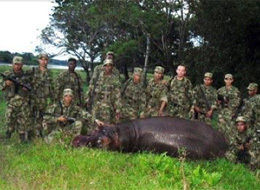
Then we walked around the excellent new gallery exhibition. A piece with 7000 toy soldiers lined up against a single toy hippopotamus, refers to an absurd incident when after Pablo Escobar was killed, his personal zoo was abandoned, and nobody wanted to enter his land. One hippo escaped in the search for food. This hippo, since it belonged to Pablo Escobar, was tracked down by the army and killed. Here is a picture of the group of soldiers celebrating their victory:
Another piece, has a wall covered in framed little plastic bags, and next to it, a device with a motor and a fan, and a plastic bag attached to it, replicating the action of huffing glue from these little plastic bags that is common among some poor children here. I found this piece very upsetting. The rhythm of the fan increasing and decreasing meshed with the repeated image of the bag was haunting, suffocating.

Monday morning I spent a couple hours in a meeting of thirty women at 'Mujeres Que Creen' to discuss properties of plants and the concept of 'Ecofeminism.' Me and Juan were the only males in the room. I sat next to Olga Patinio, an expert on plants who spent many years in the jungle in an apprenticeship with a native Shaman to learn what she knows. And it is clear in her delightful demeanor. She got up to speak; and she can control a room in an instant, turning from utterly entertaining to sincere and meditative on a dime. They've invited me to return as these talks continue, so I'm going to try to be there when my schedule abides.

I've been offered another job during my remaining time here, working for a group called 'Imagineros.' It would mean a substantial time commitment on a very specific schedule, such that I probably wouldn't be able to do some traveling I was thinking about doing. The project is funded by the Alcaldia, the city government, so it might be a really great opportunity. Just yesterday afternoon I was getting details on the six day jungle trek I can take, and I really would love to attend the International Theatre Festival in Manizales at the end of October. But it looks like if I take this job, I wouldn't be able to do either. Colombia, you tease!

Sunday, September 19, 2010

Papas Fritas

The University of Antioquia is closed down, at least until Monday, but possibly for longer, in order to 'restore security.' The 'Assemblies,' the student organizations which present political opposition, have been quite active in the past week. For students, the sound of 'papas,' little bombs going off, and people in masks running around, are not exactly uncommon. Although most Universities are five years long here, it is rare for students to leave the University of Antioquia in five years, because it is often organized within certain majors for students to boycott classes as a way of wasting the University's money in political opposition. A single semester can take a few extra months, or a whole year to complete. In particular, they have been opposed to the 'TIP,' an identity card required of every University student. Some believe there is a GPS chip installed in these cards that can track students everywhere they go, but most students I have spoken with find this ridiculously paranoid. A month and a half ago they bombed a computer system connected to the TIP. On the 13th of this month the TIP was fully implemented, and after some opposition at the start of the week, on the 16th the Rector of the school announced that the implementation of the TIP was 'a decision irreversible and un-negotiable.' The student opposition erupted even more in response, resulting in the police coming in and shutting down the University. The student groups are referred to as 'insurgents' and 'terrorists' in the media here. I guess the political language for the demonization of institutional/state opposition is consistent. I've been told to be careful around this campus because a general anti-imperialist sentiment is common in the community. 'Yankees go home!' is an often heard chant. But nonetheless, I'll start teaching at this University a little over a week from now, should it reopen.

I know they're in Spanish, but check these out, and maybe you can use Google translator:
I returned to the 'Arte y Infancia' program yesterday to help Oneides by doing some exercises on character creation with those students, then had my second, and luckily last, day of performing the Dr. Seuss songs at the Festival de Libros. It was fine, better than last week, but I don't think I could ever work consistently singing kids songs. Juan was running an event right after me, so I watched Emmanuel while he taught drawing. Being a parent must be like sacrificing yourself on the alter, and becoming a new, without-self, solely preoccupied the safety of the anarchic force you have created. I saw a group of Apaches from Arizona give a presentation at the Colombo on Friday, then had a bite with them and other Colombo staff. At night I went to Tango show at Teatro Lilo, featuring Veronica, a friend of Danny from Renovacion. Thursday night I went to 'De Dos Amores,' a comedic version of Federico Garcia Lorca's 'Boda de Sangre' or 'Blood Wedding,' which was really fantastic. I was almost crying from joy during a surreal moment when Leonardo is conducting an orchestra of the the other characters' movements. Raol, one of the actors I was working with at Nuestra Gente, invited me, and was excellent in this role. All three men in drag were fabulous as well. I enjoyed the production's attitude towards reality: post-modern if you want to categorize its style. Then we stopped into a bar with live 'ranchero' music for a bit.

Work continues to be excellent. In addition to Circo Momo, Nuestra Gente, San Ignacio, and Maria Cano, all moving forward differently this week, I taught in English on Wednesday to a high school age 'integrated skills' English class from the Colombo. I was able to reflect differently after teaching in English, on how Boal's exercises function as a metaphor for how individuals act relationally: how someone uses power, how someone treats someone else in power, how much trust someone can give, how comfortable someone is being spontaneous and playing in front of others, etc. Of course these are motifs I'm concentrating on overall, but I was reminded of this 'relational parallel,' you might be call it, by processing after the workshop in English. Especially after working with the professional actors from Nuestra Gente, feeling quite strongly their confidence in themselves, their unwavering dedication to each exercise, their respect and trust in the others in their group, working with this group of high-schoolers totally unaccustomed to working physically in a group setting, helped reawaken me to the subtleties of distrust and disrespect. It is so easy to abuse power when you have it, even if it is masked as a joke between friends. I had to really yell after a student kicked someone who had their eyes closed. What makes someone unable to invest themselves in a simple game, or follow simple instructions, or lash out at another after an experience of vulnerability, is of course fear. And I'm finding that with a clear ritual I can often assuage some of these fears that would otherwise pop up. But when I enter a group dynamic already established, it is a slow process of altering that dynamic. My ability to control my own presence in the room in general is definitely still hampered by the language barrier. I'm comfortable putting in this little bit of class processing here, because it is a group I will never return to again, and I have not been overly specific.

It's raining again today. It's been raining a little bit most days this week, but usually not for more than an hour or two. And I guess...I guess as I lie here in slippers in a hammock on a rainy Sunday, wondering whether to try to find a place to get a hair cut or translate some exercises I want to try for this week, or go have lunch at Taller 7, I feel mostly solid. I didn't go out last night, I stayed in and read. Despite how nice the friends are I've made here, social interaction can be tiring sometimes, because I still don't understand everything unless people speak slowly. And so I thought about silence. It's something I'm always insisting on in my workshops. But students somehow find a reason they need to talk. My tendency is to consider it an attempt to comfort themselves or escape the direct experience. So my job is to insist on the direct experience. But if my own fear is connected to verbal communication then my silence is the escape. For now, I feel the respite is justified. Tomorrow, to confront again. The language, and hopefully in my own way, the silence. Because there is a lot more to silence than merely the lack of words. Ah, it stopped raining already. What's worth doing with a Sunday?